In waterborne coating applications—whether involving furniture finishes, wood coatings, or industrial water-based paints—the uniformity and evenness of the coating directly impact the product's appearance and performance. A core factor underlying these issues is the ability of the coating to wet and spread across the substrate. This is particularly critical on low-surface-energy or difficult-to-wet substrates, where water-based systems are prone to defects such as cratering, mottling, and retraction. Consequently, selecting an appropriate substrate wetting agent constitutes a vital step in enhancing the application performance of water-based coatings.
Wetting and Spreading in Water-based Coatings
Substrate wetting refers to the process by which a liquid water-based coating establishes full contact with a substrate surface to form a continuous film; spreading is the liquid's ability to diffuse uniformly across that surface. In water-based coating systems, surface tension is the critical factor influencing both wetting and spreading: water-based coatings typically possess high surface tension, whereas substrates such as plastics, metals, and wood often exhibit low surface energy. Consequently, the liquid tends to form droplets, retract, or adhere unevenly in localized areas.
Substrate wetting agents are a class of additives designed to facilitate the rapid wetting and uniform spreading of liquid systems across a wide variety of substrate surfaces. Their primary function is to reduce the system's surface tension and enhance the liquid's wetting capability relative to the substrate, thereby achieving a more uniform and stable surface finish.
The Critical Role of Substrate Wetting Agents
Effective substrate wetting enables the coating system to form a continuous, level film on the substrate surface, thereby enhancing both its aesthetic appearance and functional performance. For instance, wetting agents help to:
Improve leveling effects, resulting in a flatter and smoother surface finish;
Enhance adhesion uniformity and minimize application-related defects;
Reduce the incidence of surface imperfections such as crawling, pinholes, and fisheyes;
Improve adaptability to substrates with low surface energy.
Conversely, if wetting is inadequate—meaning the liquid fails to spread sufficiently—problems such as coating retraction, edge buildup, localized substrate exposure (holidays), mottling, or crawling are likely to occur. These issues are particularly pronounced on substrates such as plastics, wood, metals, and composite materials.
Common factors contributing to wetting issues in water-based coatings include:
Low Substrate Surface Energy or Contamination: Examples include plastics, treated metals, or surfaces covered in oil residues or dust.
High Coating Surface Tension: Water-based coatings typically possess higher surface tension than traditional solvent-based coatings.
Insufficient Internal System Compatibility: Uneven dispersion of additives or fillers can create localized variations in surface tension.
Environmental Influences: Factors such as air humidity, airborne dust, and temperature fluctuations can lead to uneven surface spreading.
In the context of water-based systems, traditional wetting agents often exhibit limitations regarding their efficacy on low-surface-energy substrates, their ability to control crawling, and their dynamic wetting capabilities.
Advantages of Silicone Substrate Wetting Agents in Water-based Coatings
Silicone substrate wetting agents facilitate faster wetting of substrate surfaces and promote uniform spreading by significantly reducing the dynamic surface tension of the system. Even when applied to low-surface-energy substrates, they improve coating quality and minimize application defects.
Silicone wetting agents demonstrate particularly outstanding performance in water-based coatings, high-solids systems, and under complex application conditions; they effectively mitigate issues such as cratering, Bénard cells (flow patterns), and surface irregularities caused by insufficient wetting.
Silicone substrate wetting agents typically feature a polyether-modified silicone structure, combining the distinct properties of both silicone segments and hydrophilic groups.
Specifically, the silicone segments endow the product with extremely low surface tension, enabling it to migrate rapidly to the air-liquid interface; meanwhile, the polyether segments ensure excellent compatibility and system stability. This unique structure strikes a balance between wetting efficiency and formulation compatibility, demonstrating excellent adaptability across a wide range of resin systems.
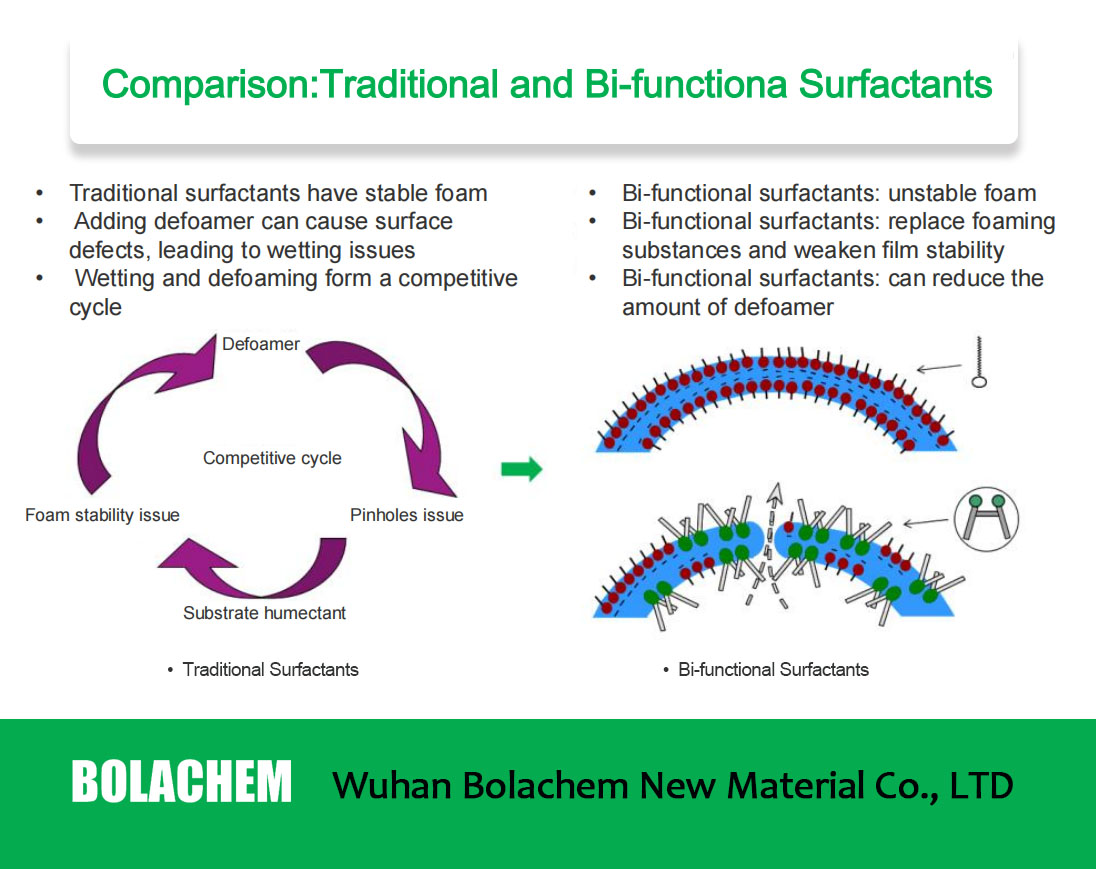
Comparison with Traditional Wetting Agents
While traditional wetting agents possess some capacity to reduce surface tension, they often exhibit limitations regarding the wetting of low-surface-energy substrates, crater prevention, and compatibility within complex systems.
In contrast, silicone substrate wetting agents offer lower surface tension, faster dynamic wetting capabilities, and superior defect-prevention effects, making them particularly well-suited for applications where high surface quality is a critical requirement.
Typical Applications in Water-based Coatings
Silicone wetting agents are widely utilized in systems such as water-based furniture finishes, wood coatings, industrial water-based paints, adhesives, printing inks, and inkjet inks. In these applications, their primary function is to enhance surface leveling, minimize cratering, and improve the wettability of low-surface-energy materials. For instance, Bolachem offers a diverse range of silicone-modified wetting agents capable of serving as below:
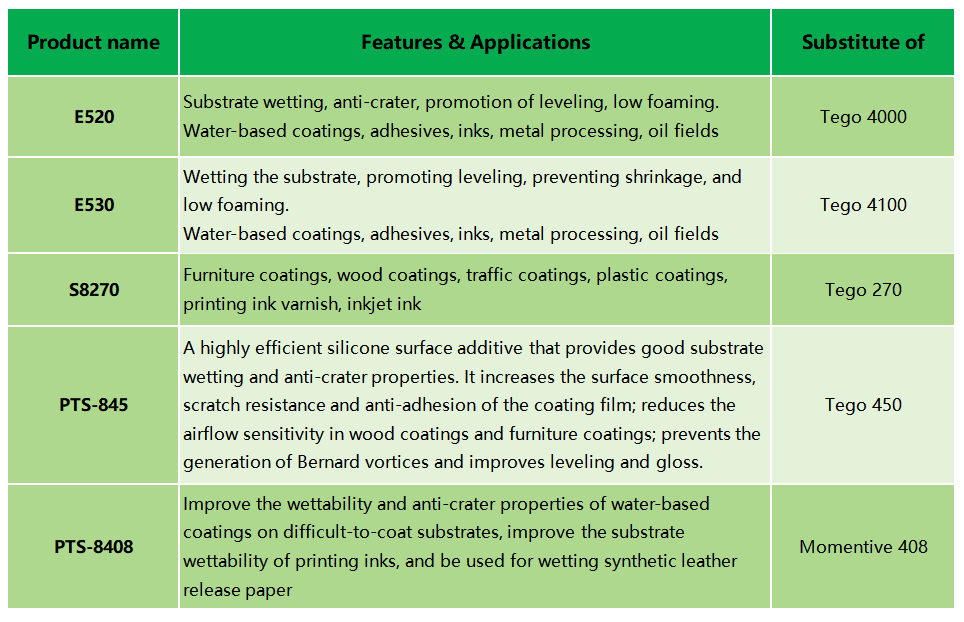
Each specific model possesses distinct characteristics regarding wetting speed, cratering resistance, and system compatibility. These attributes can be clearly compared via a product specification chart, thereby assisting customers in selecting the optimal solution tailored to their specific water-based coating formulations.


